How AI in Marketing Is Changing the Way Teams Work — Backed by Real User Data
Table of Contents
- The Adoption of AI in Marketing
- Key Benefits of AI in Marketing
- Real-World AI in Marketing Examples
- How Marketers Are Using AI Today
- How to Choose The Right Marketing AI Tools
- AI Challenges and Considerations
- Our Prediction For The Future of AI in Marketing
- Key Takeaways
- FAQs
Artificial intelligence is transforming how marketers plan, create, and measure campaigns. Once limited to experimentation, AI has become essential for driving efficiency, improving personalization, and uncovering insights that fuel growth. Yet despite the buzz, most marketers approach AI pragmatically—they want tools that save time, align with their workflows, and deliver measurable ROI.
The Adoption of AI in Marketing
AI in marketing refers to the use of artificial intelligence technologies—such as machine learning, automation, predictive analytics, and generative AI—to enhance how teams plan, execute, and optimize campaigns. In short, it is the application of intelligent systems to make marketing more data-driven, efficient, and responsive.
Examples of AI in use span the full marketing funnel:
- Machine learning identifies audience patterns and optimizes targeting.
- Automation manages repetitive tasks like lead scoring and campaign scheduling.
- Predictive analytics forecasts outcomes such as conversions, churn, and ROI.
- Generative AI—tools like Jasper, Writer, and ChatGPT—creates written or visual content at scale.
Together, these technologies free marketers to focus on creativity and strategy while AI handles the analysis and execution behind the scenes.

This article examines the key benefits of AI in marketing, real-world examples of its use, insights from marketers adopting these tools, and how to select the right solutions based on verified peer feedback. It concludes with a discussion of emerging challenges, future trends, and actionable takeaways for responsible adoption.
Learn more about the types of AI and how similar innovations are shaping AI in sales.
Key Benefits of AI in Marketing
AI delivers measurable value across the marketing funnel. From smarter personalization to predictive insights and improved automation, the technology enhances every stage of engagement.
Smarter Personalization and Targeting
AI enables one-to-one marketing at scale. Using behavioral and demographic data, personalization engines analyze user intent and tailor experiences across email, web, and advertising. Marketers report higher engagement and conversion rates when campaigns dynamically adjust to user behavior in real time.
Faster Content Creation and Optimization
Generative AI tools like Jasper and Writer accelerate content production and SEO optimization. They assist in drafting, keyword analysis, and tone calibration—helping teams test ideas and deploy campaigns faster. Marketers note that while AI speeds creation, human review remains vital for maintaining brand voice and accuracy.
Predictive Insights for Better Decisions
Predictive analytics convert data into foresight. By modeling patterns in performance and audience response, AI helps marketers allocate budgets, refine targeting, and forecast outcomes. B2B teams, in particular, rely on predictive tools for pipeline visibility and ROI measurement.
Improved Marketing Automation and ROI
AI-driven automation ensures campaigns are delivered at the right time and channel. TrustRadius reviewers frequently highlight measurable ROI gains from enhanced segmentation and performance optimization, as well as the time saved on manual execution.
Real-World AI in Marketing Examples

Across marketing disciplines, AI tools are reshaping daily workflows. They automate routine processes, surface actionable insights, and enable deeper personalization at scale. From SEO and social media to CRM and retention marketing, AI now underpins how teams create, analyze, and adapt their strategies in real time—driving both efficiency and growth.
Content and SEO Optimization (e.g., Jasper, Writer, ChatGPT)
AI-powered writing tools streamline ideation, drafting, and content refinement. AI writing assistants like Jasper and digital content creation platforms enable marketers to scale their output while maintaining quality. Users appreciate automation in keyword research and tone optimization, though many stress the importance of human editing for originality and depth. For quality control, writing and proofreading tools ensure clarity and consistency across large volumes of text.
CRM and Predictive Analytics (e.g., HubSpot, Salesforce Einstein)
Customer relationship management tools integrate AI to predict lead quality, personalize outreach, and streamline data management. CRM platforms, when paired with sales acceleration and predictive analytics tools, create a unified view of customer behavior. Reviewers on TrustRadius highlight HubSpot’s predictive scoring for improving lead prioritization and Salesforce Einstein’s effectiveness in forecasting revenue trends.
Marketing Automation (e.g., Marketo Engage, Klaviyo AI)
AI-enhanced marketing automation software helps teams orchestrate complex, multi-channel campaigns that adjust automatically to audience engagement. When integrated with marketing analytics tools and sales and marketing platforms, these systems deliver campaigns with precision and measurable impact.
Marketers reviewing Klaviyo AI on TrustRadius note its strong automation capabilities but want more creative control.
How Marketers Are Using AI Today
We recently released a report about AI usage in the workplace. In this survey, we found that marketers were the third most-likely group to use AI (behind engineering and product teams). 70% of marketers who use AI use it daily, and 98% use it almost weekly. Additionally, marketers at enterprise companies (1,001+ employees) are most likely to use AI daily, indicating that these large businesses are investing in AI tools (and possibly training).
Daily AI Usage in Marketing Varies Across Business Size
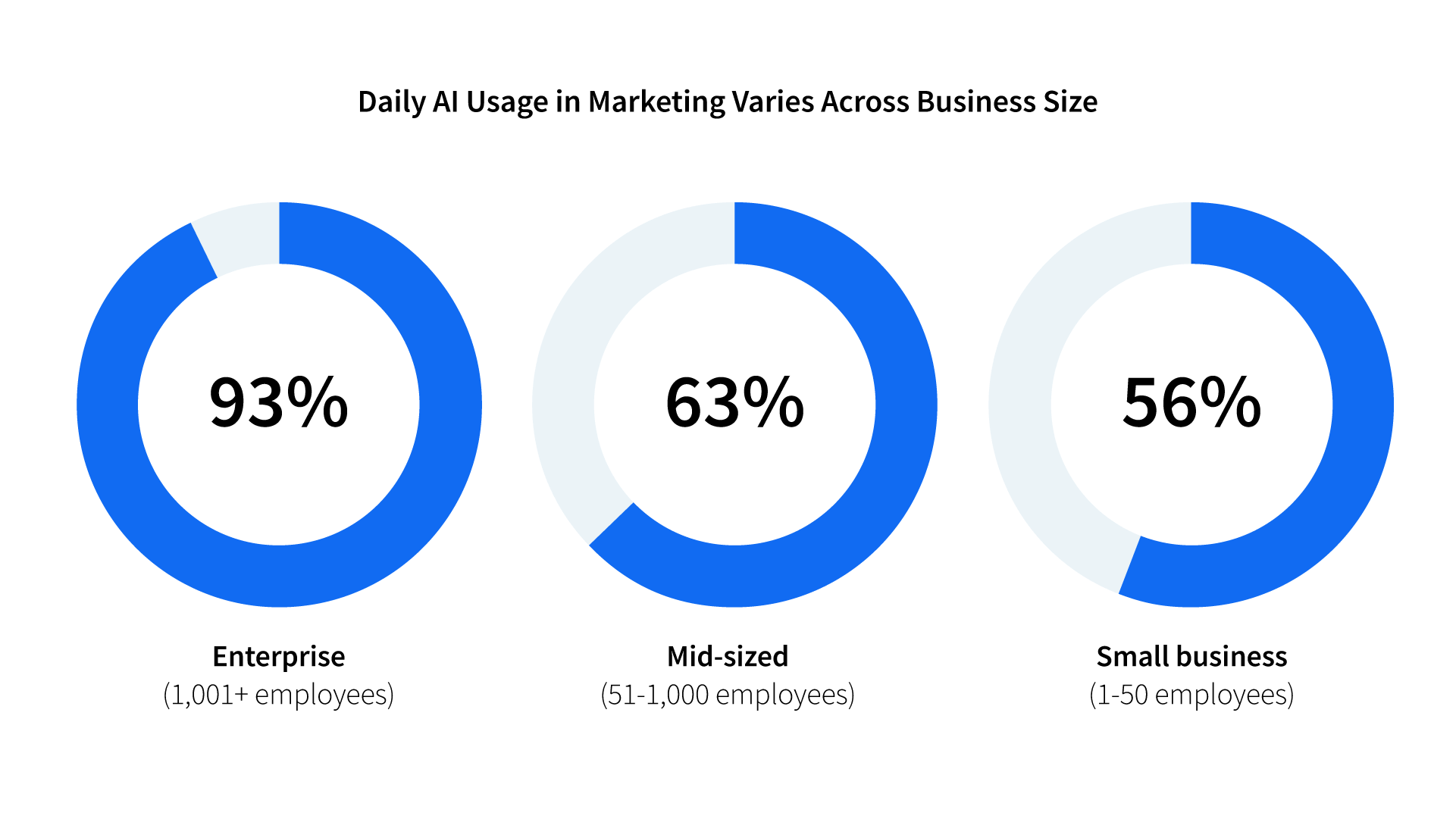
- 93% enterprise (1,001+ employees)
- 63% mid-sized (51-1,000 employees)
- 56% small business (1-50 employees)
Marketers leveraged AI for a wide variety of use cases ranging from more creative pursuits like writing, to more analytical tasks such as data analysis. Based on our survey, the top 5 AI use cases for marketers are:
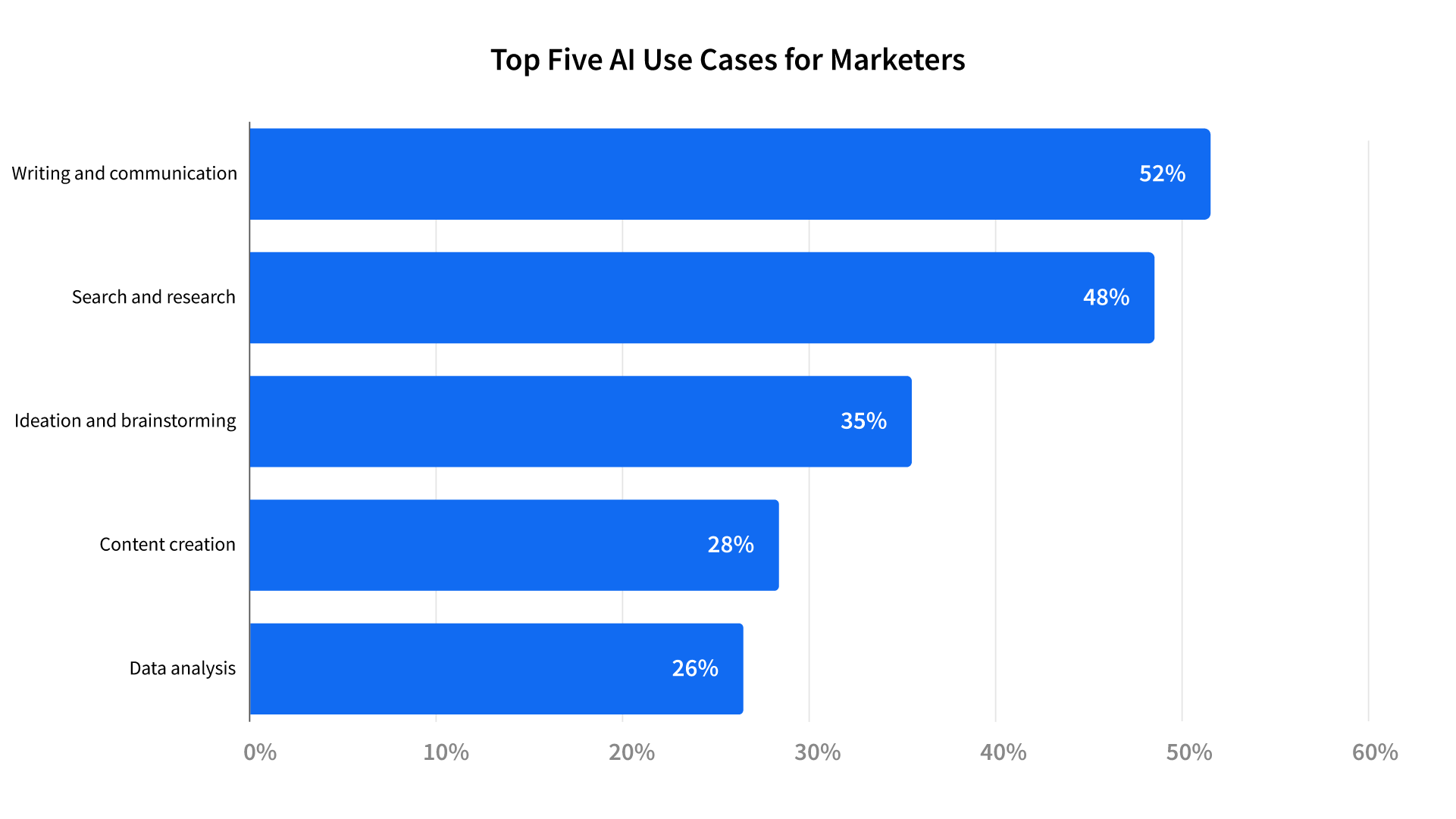
- Writing and communication (52%)
- Search and research (48%)
- Ideation and brainstorming (35%)
- Content creation (28%)
- Data analysis (26%)
Common Questions Amidst AI Adoption
As with every new technology, AI has a learning curve. When asked what they would ask an AI expert, here are the top responses from the marketers in our survey:
- Most effective prompts (22%)
- Use cases for AI (20%)
- Better integration into workflows (17%)
- How to apply AI to their role (17%)
While we can’t say for certain, these trends might mean that the AI tools marketers are using aren’t sufficiently integrated into their workflows, making it difficult to leverage them effectively. Alternatively, since the technology is so new, some marketers may just need training on how to prompt more effectively or how these tools can be used for their specific role. With that in mind, it makes sense that our survey indicated AI is more widely used by marketers at enterprise companies who are more likely to have the resources to buy use-case specific tools and/or facilitate training initiatives.
Policy vs. Progress
Another challenge facing marketers looking to embrace AI are their company’s AI policies. 48% of marketers said their companies had a policy about AI use. Of that group, 28% felt the policy was too restrictive. Only 4% felt their company’s policy was too permissive. According to our data, marketers were the second most likely to feel that their company’s AI policy was too restrictive, behind finance professionals.
With this in mind, we think it’s possible company AI use policies are being written without marketing job functions in mind, preventing marketers from experimenting with tools that fit better into their workflows or using company data they need to do their jobs effectively with AI.
How to Choose The Right Marketing AI Tools
Selecting the right AI tools in marketing is less about chasing novelty and more about identifying technologies that align with real business goals. The range of available tools can be overwhelming, but a structured, evidence-based approach simplifies the process. By defining what success looks like, consulting verified peer reviews on TrustRadius, and evaluating integration and ROI potential, marketers can move from theory to action—choosing tools that enhance strategy rather than complicate it.
1. Define Your Goals Before Selecting Tools
Start with clear objectives. Whether your priority is improving targeting, accelerating content creation, or enhancing attribution accuracy, tools should directly solve these needs. Avoid adopting AI for its own sake—focus instead on measurable impact.
2. Compare Tools by Verified Reviews, Not Just Features
Feature lists show what software can do; reviews reveal how it performs in real conditions. TrustRadius provides detailed, verified feedback from marketers who evaluate usability, integration, and ROI across diverse contexts. Explore top-rated AI marketing tools on TrustRadius to compare satisfaction and fit by industry, company size, and use case.
3. Consider Integration, Ease of Use, and Real ROI
The best AI tools integrate seamlessly with your existing CRM, analytics, and automation stack. Verified reviewers frequently emphasize implementation complexity and learning curves as key decision factors. TrustRadius comparison filters help teams identify solutions that align with their technical environments and deliver tangible returns.
AI Challenges and Considerations
AI’s rise in marketing brings both promise and responsibility. Marketers must weigh innovation against ethics, transparency, and accuracy to ensure AI strengthens rather than undermines trust.
- Ethical Concerns and Data Privacy
AI systems depend on large datasets, raising questions about consent, bias, and privacy. Teams must comply with regulations such as GDPR and prioritize transparent data practices that protect user information. - Content Authenticity and Brand Voice
Generative AI can produce large volumes of content quickly, but may dilute tone or originality. Maintaining a strong human voice—and ensuring that AI outputs reflect brand values—is essential for authenticity and differentiation. - Accuracy and Over-Reliance on AI
Even advanced AI can misinterpret data or generate misleading insights. Some marketers told TrustRadius they struggle to validate AI-generated results without human review, highlighting the need for oversight and balanced decision-making.
“One of the biggest challenges is context. AI tools often lack awareness of internal systems, product nuances, or real-time customer data, which limits their ability to provide precise, actionable recommendations. They also sometimes overgeneralize or generate content that needs heavy refinement to fit brand tone, regulatory requirements, or localized customer behavior.” – Manager in Marketing, 10,001+ employee company
Our Prediction For The Future of AI in Marketing
The next phase of AI in digital marketing will emphasize partnership over automation—AI as a creative and analytical copilot. Emerging trends point toward greater collaboration between humans and machines:
- Predictive analytics will evolve from descriptive dashboards to proactive decision support.
- Creative automation will blend generative content with brand governance systems for more consistent messaging.
- AI copilots embedded within CRMs and analytics suites will assist with research, recommendations, and campaign orchestration.
Industry leaders such as IBM and Salesforce project that AI will underpin nearly all marketing functions within five years. Yet TrustRadius data shows marketers value transparency and human input, suggesting a hybrid future where AI amplifies human expertise rather than replacing it.
Key Takeaways
- AI is not a replacement but an enhancer of marketing strategy. When used responsibly, it strengthens creativity, accelerates execution, and provides data-driven clarity without displacing human insight.
- Success depends on alignment and focus. Teams that define clear goals—whether personalization, automation, or analytics—achieve the strongest ROI.
- Peer insights are the most reliable guide to real-world performance. Verified TrustRadius reviews reveal how AI tools deliver value beyond vendor claims.
- Ethics and authenticity remain non-negotiable. Marketers should balance innovation with privacy, accuracy, and brand integrity.
- Before adopting new tools, consult verified reviews on TrustRadius. Real user feedback offers the clearest picture of how AI solutions perform across industries and teams.
FAQs About AI in Marketing
What are examples of AI in marketing today?
Examples include AI-powered personalization engines, chatbots, predictive analytics, and generative writing tools like Jasper and Writer.
How can small teams start using AI in marketing?
Begin with affordable, low-barrier tools that automate repetitive work—such as content generation or campaign scheduling—and scale to predictive analytics as data sophistication grows.
What is the future of AI in digital marketing?
Expect deeper integration across CRM, analytics, and automation systems. AI will increasingly act as a strategic copilot, surfacing insights that guide creative and operational decisions.
What are the benefits of AI in marketing automation?
AI-driven automation reduces manual effort, improves targeting accuracy, and maximizes ROI by ensuring campaigns reach the right audience at the right time.