
Top Features for Enterprise Resource Planning (ERP) Software
Enterprise Resource Planning (ERP) software focuses on integrating and managing core business processes, much like a central nervous system, by connecting finance, supply chain, human resources, and manufacturing within a single, unified platform. ERP systems automate workflows and provide real-time data to enhance efficiency and inform better strategic planning across an enterprise. ERP systems tie multiple business processes together, enabling data flow across a business workspace. Gathering a company’s shared transactional data from different sources, an ERP system detects and eradicates data duplication. The top features for Enterprise Resource Planning software mentioned in the article are some of the most vital to selecting the right ERP product for your business.
Top Enterprise Resource Planning Software Features
Product Master Data Management
Product Master Data Management (PMDM) in an ERP system offers centralized and standardized product data like specifications, descriptions, pricing, and images, creating a one-stop, reliable source of truth. This system ensures consistency and data accuracy across different departments, helping improve decision-making, operational efficiency, and reducing errors.
Benefits
- The system manages a single source for all product information through consolidated data gathered from various sources to remove duplication.
- The system ensures consistent, accurate, and up-to-date product data flowing across an organization. This information is important for the supply chain, sales, marketing, and other operations.
- The system improves efficiency through trusted sources of data, reducing the time spent searching for data.
- It enables corporations to work on better decision-making through a unified product data source that allows improved sales strategies.
- Risks are reduced by ensuring compliance with industry and regulatory standards. This paves the way to providing reliability and authenticity.
Acumatica
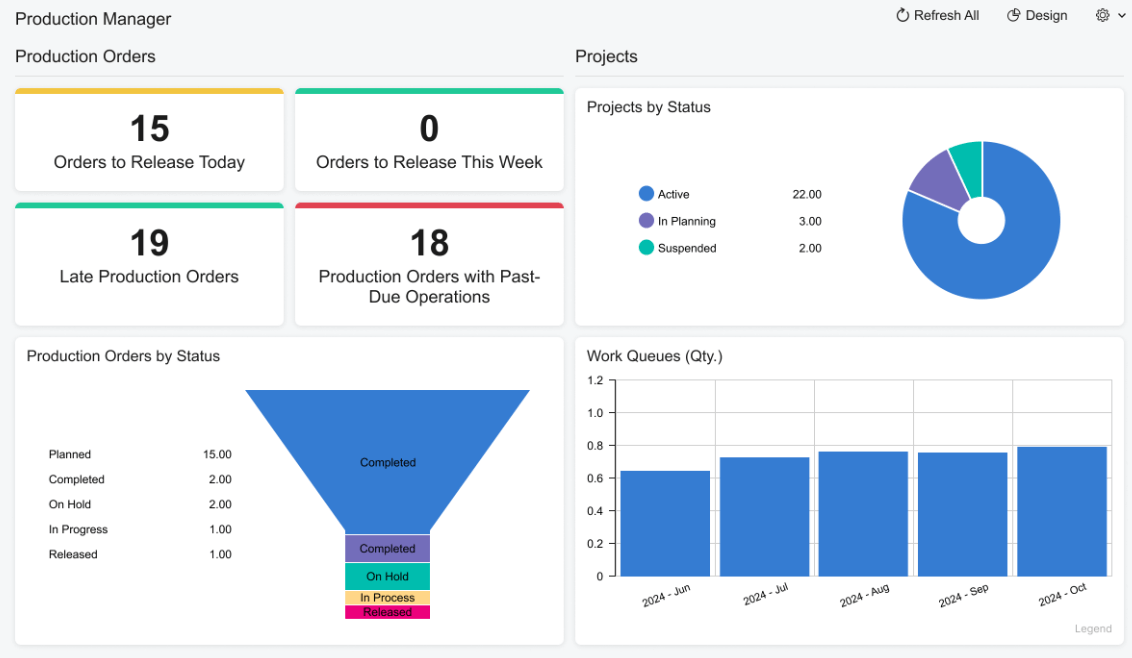
Acumatica offers a comprehensive suite of cloud-based business applications designed to streamline operations through customizable dashboards, robust reporting tools, integrated document management, and centralized security. It creates, classifies, and manages product items, BOMs, and product changes. Acumatica users have scored the feature 7.7 in their TrustRadius reviews.
“Acumatica is our ERP system….We additionally use work order management for service and repairs, and inventory for tracking and charging parts….Their modern web-based and user-customizable interface makes it the right product for us.”
Read this Verified User’s full review here.
Performance Monitoring
Performance monitoring in an ERP software includes constant evaluation for system reliability, efficiency, and stability through metrics and tools. The process uses various methods and tools to track speed, Enterprise Performance Management (EPM) to manage operational and financial data, and gain user satisfaction, ensuring the system achieves business objectives.
Benefits
- The system monitors specific metrics for Key Performance Indicators (KPIs) to support business objectives.
- Project-based KPIs such as timing variance, cost variance, resource utilization, and overall productivity can be tracked by the system.
- The software uses built-in dashboards and reporting to manage multiple views of operational performance.
- The system quickly and easily identifies and resolves issues by using agents to track every transaction step-by-step and gather data from user browsers.
M1
M1 analyzes business metrics and compares actual performance to plans, identifies issues, prioritizes demand, and responds to changes. It also statistically forecasts based on historical patterns and sales input, monitors accuracy, and estimates new demand. M1 users have scored the feature 8 in their TrustRadius reviews.
“We use M1 in every aspect of our business. From quoting to AP. It gives us an all-inclusive solution to manage our business from front to back. Including reporting on existing and past jobs for costing and analytics. We love that we can customize M1 to fit our needs and have customized it extensively.”
Read this Verified User’s full review here.
Inventory Tracking
Inventory planning in an ERP software system uses a one-stop integrated platform to manage orders, inventory, and deliveries by connecting multiple departments, such as finance, sales, etc. It offers real-time visibility, forecasts demand, prevents stockouts, and minimizes overstocking, which streamlines operations and improves efficiency.
Benefits
- The tool keeps inventory tracking centralized for businesses with multiple warehouses or stores, providing a unified view from a single platform.
- It streamlines data entry, inventory counts, and processing orders to reduce manual efforts and human errors.
- Automated re-ordering of stocks is a vital function of the app, where it automatically generates purchase orders whenever the stock is exhausted, keeping all the relevant teams, like sales and inventory, aligned with the updated information.
- It can also forecast future demands by keeping an observation of stock history and inventory data.
SAP S/4HANA Cloud
SAP S/4HANA Cloud is a modular ERP platform that empowers organizations to manage mission-critical operations in real time, launch innovative business models across industries, and scale globally with confidence. The software syncs orders and stock to maintain a real-time picture of inventory and supports multiple methods, like LIFO and FIFO. It also helps track and manage raw materials, work-in-progress items, and finished goods. SAP S/4HANA Cloud users have scored the feature 8.3 in their TrustRadius reviews.
“[SAP S/4HANA Cloud] improved 15% forecasting accuracy & also better inventory utilizations…[it’s] well suited for real time financial consolidations,
procurement & supplier vendor managements for enforcing consistency & compliance, [and] inventory optimizations & planning for accurate stock visibilities.”
Read Senthil’s full review here.
Control Management
Control management in ERP software encompasses the tools and functionalities that enable organizations to effectively monitor and govern their operations. These systems integrate key features such as financial tracking, quality assurance, inventory oversight, and user access controls. By centralizing data and streamlining workflows, ERP platforms empower businesses with real-time operational visibility, enhanced strategic planning capabilities, and informed, data-driven decision-making across all departments.
Benefits
- The system facilitates businesses in managing budgets, tracking expenses, and monitoring financial performance in real-time. It helps accounting, invoicing, and financial analysis, as well as offers a foundation for strategic long-term planning and informed investment decisions.
- The app controls various business processes, ensuring all processes align with common business objectives.
- The system controls inventory and supply chain management through centralized tracking of raw materials, finished goods, and vendor relationships.
Intuit Enterprise Suite
Intuit establishes and updates the risk with the control matrix, control test plans, and instructions. It creates, classifies, and manages product items, BOMs, and product changes. It also takes care of capture budget, resource, and benefit expectations for proposals. The suite is an end-to-end business platform with next-level production management skills. Intuit users have scored the feature 7.3 in their TrustRadius reviews.
“I am the Operations Manager for our company. I use IES to run reports, set up projects, bill out clients and issue payments to vendors. The ease of access to knowledge and the ability to ask for help is unparalleled. You can see your finances and projects all at once and can manager your team with all the reports that are made available to you.”
Read Douglas’s full review here.
Warehouse Workforce Management
An ERP system enhances integration with a Warehouse Management System (WMS), enabling efficient oversight of warehouse operations. It also helps optimize labor utilization and automates key processes such as receiving, putaway, picking, and shipping. By delivering real-time data and comprehensive visibility across the supply chain, it improves inventory accuracy, increases productivity, minimizes errors, and supports seamless operational coordination.
Benefits
- Inventory management is efficiently controlled by the system, by tracking stocks with real-time data. The features of managing bins, tracking ownership, and optimizing space make this app unique.
- It takes care of order fulfillment by optimizing picking and packing orders at the right speed and accuracy. Shipping and returns are also streamlined correctly.
- It optimizes and coordinates with warehouse stock through task prioritization, scheduling, and performance tracking.
Epicor Kinetic
Epicor Kinetic is a cloud-based ERP platform engineered for manufacturers, offering deep product-centric functionality with extensive customization and scalability. It sets goals, measures actuals, and analyzes productivity for warehousing tasks and activities. It also assists in executing and tracking shipping orders. Epicor users have scored the feature 8.2 in their TrustRadius reviews.
“TJ Hale currently uses Epicor ERP software to handle our supply chain and scheduling/manufacturing of our engineer-to-order items. We use the software to handle everything from the initial sales order through the manufacturer and the purchase of component items. We finally use the accounting features of the software to provide financial reporting. Everything that can be done through Epicor is currently being done.”
Read Michael’s full review here.
Production Management
Production management within ERP software integrates manufacturing processes into a centralized platform, allowing businesses to efficiently plan, schedule, execute, and monitor production activities. Real-time insights into inventory levels, cost structures, and workflow status enhance resource allocation, streamline operations, boost efficiency, and reduce bottlenecks. Integrating production with key functions like finance, procurement, and supply chain management, ERP systems enable smarter decision-making and agile responses to evolving market demands.
Benefits
- Production planning and scheduling are efficiently created by the system with smooth workflows and schedules with integrated data from different departments.
- Resource management through ERP software optimizes resource allocation, raw materials, machinery, and labor, depending on availability and production needs.
- With the system’s quality control, ERP ensures quality standards are maintained for products, incorporating inspections, quality planning, and corrective actions.
- An ERP software can control costs and analytics, providing insights on production costs at each step, managing budgets, and measuring the return on investment (ROI).
NetSuite ERP
NetSuite ERP provides centralized critical status information for production supervisors. It manages product process designs with ease by defining data for plant hierarchy, process standards, work areas, calendars, and standard operations. NetSuite is a comprehensive ERP and accounting platform offered in multiple editions, each tailored to meet the needs of businesses of varying sizes. NetSuite ERP users have scored the feature 8.9 in their TrustRadius reviews.
“I use NS in our organization to do everything from booking journal entries, creating reports, publishing financials, maintaining fixed assets, issuing debt and recognizing revenue and lease liabilities/assets.In my opinion, NS is the most intuative and logical ERP system versus PeopleSoft, SAP and even Microsoft Dynamics. I have had the opportunity to use the system as an admin, reviewer and preparer for all finance and accounting functions.”
Read Christopher’s full review here.
Project Planning and Scheduling
Project planning and scheduling in ERP software leverages integrated tools to establish timelines, assign resources, and track progress within a unified system. It enables teams to deconstruct projects into manageable tasks, define dependencies, and build visual schedules using tools like Gantt charts and Kanban boards. With access to real-time data, organizations gain improved control over budgets, optimize resource allocation, and make well-informed decisions throughout the project lifecycle.
Benefits
- Project planning plays a vital role in an ERP system by turning projects into tasks and defining their durations.
- The system offers resource management by controlling and tracking resource availability across multiple projects.
- It also searches for and assigns the right resources based on their skills and location.
- Real-time information is used for teams on the ground to plan capacity and manage workload. It also manages budgeting and controlling costs.
Zoho One
Zoho One is an all-in-one business suite from Zoho Corporation that unifies its sales and marketing tools with a broad range of applications for financial management. It equips organizations with an Interactive Gantt chart for establishing tasks, durations, and delivery schedules. It has capabilities for project functions such as updating and monitoring task progress and timecards from mobile devices. Zoho One users scored the feature 9.5 in their TrustRadius reviews.
“It is the single platform we use to operate our entire business other than the web browser. I’ve been a long time Zoho user starting with Zoho CRM and then a year or so later, began using Zoho Books, and then Zoho Mail. Once Zoho One was released which is the all inclusive subscription which includes at the time about 40 Zoho modules, I was sold as it was the more economical option and was a full integrated approach to operating our business. Most recently we’ve incorporated Zoho Payroll which we’d been waiting for and so far, love it.”
Read Stephen’s full review here.
Choosing the Top Features For Enterprise Resource Planning (ERP) Software
ERP software plays a vital role in businesses to automate and integrate tasks of multiple departments by using a single platform. The software offers seamless coordination across Sales, marketing, procurement, production, and other teams to function efficiently, staying updated with the changes taking place across an organization. Considering the few top features for Enterprise Resource Planning software mentioned in this article, companies must ensure they buy suitable software for their workspace that meets business goals and also stays cost-effective.
To continue your research, explore the Enterprise Resource Planning (ERP) software on TrustRadius. You can compare products, read verified reviews, and see which solutions best fit your needs. You may also find value in related categories and resources, including: